Pages

Across the Board (ATB) Talent, founded in 2008 by entertainment professional and entrepreneur Guy Kochlani, is a full-service licensed Talent Agency. ATB represents its talent "across the board:" theatrically, commercially, in print, hosting, voiceovers and dance. The limited client roster and staff of 10 enables ATB to remain committed to the goal of developing high quality talent while providing the personalized atmosphere of a management company.

Across the Board’s talent has been seen on numerous TV shows, films, commercials and theatre productions. Their models and photographers have been a part of major fashion campaigns and have been seen across the pages of domestic and international magazines.

ATB is honored to announce its move up into the big leagues. Using talent from across the board, ATB is currently packaging a major feature film as well as television series. As the client list becomes larger and more high-profile projects are being tackled, founder and CEO Guy Kochlani avows: “No matter how much we expand, our original business model will always remain on point. We provide one-on-one care and service to each client, no matter what.”

ATB represents talent and models in Los Angeles, Las Vegas and New York, with offices in Los Angeles and New York-Times Square. There are plans to open offices in London, Paris, and Tel Aviv.


For more info, check us out at WWW.ATBTALENT.COM

Tuesday, August 14, 2012

AGENCY TIPS, VOL. IV: So, We Need to Talk...


            Communication is really an extraordinary thing.  Think about it for a second.  You type a message on your phone, click “SEND” and almost instantaneously your pal on the other side of the country is “lol-ing” with you.  Cyberspace has changed the way we think and function, and the idea of waiting has become something reserved solely for restaurants.  Everything needs to be now, now, now.

            But life doesn’t always work that way, does it?  Sometimes we’re faced with certain obstacles and decisions that are totally out of our control, and we have no choice but to sit and wait.  It can be an excruciating process, and we have to bite our collective lips and deal with it.

            The entertainment industry is no different.  In fact, I’d argue that its entire foundation is built on hard-earned patience, with the almost inevitable “no” at the end of that tunnel.  Still, we fight and push on, being as persistent as possible, never letting an “I’ll get back to you” find its way between success and us.  Except sometimes, that’s not quite how things work.  Sometimes we really do need to wait. 

            Here at the ATBlog we’ve been preaching nonstop about a good actor being a proactive actor…but there’s a very fine line between being a go-getter and being a nuisance.  For your reading pleasure, we’re providing a comprehensive list of everything the perfect client should never even consider doing.

“Have You Heard Anything?”

            Often times the dialogue between an actor and his or her representation will follow this track:

ACTOR
The audition went great, I just got out.  I spent more time with the Casting Director than the other actors, I think.  Yeah, the CD loved me, and started asking me all these questions!  Have you heard anything yet?”

AGENT
“No, we haven’t,” your agent replies.  “You just left the room, give it some time.  Casting Directors need to marinate in what they saw for the day, and when they’re ready to pick actors they call us.”

This could be you.
            This is the sort of badgering that can really get to your agent.  Constant update requests will do nothing but sour the working relationship with your representation.  It doesn’t matter how “buddy buddy” you may think you guys are.  At the end of the day, your agents and managers WORK for you, and don’t want to be pestered with “Have you heard anything?” type of questions.  Take a chill pill.  Why on Earth would your agent not tell you about an audition or booking?!  It’s only in some weird alternate dimension that your representation would say, “Oh gosh, thank so much for calling!  Good thing, too, since you just booked a Recurring role on Mad Men!  I wasn’t going to tell you, so this sure was convenient!”  When Warner Bros. calls about casting you as the new Batman, you’ll know.

“Why Am I Not Going Out?”

Patience, baby.  Patience.
            Whenever I hear this one, I wonder what exactly the client wants to hear.  “Your headshots are bad.”  “You’re not what they’re looking for.”  “Maybe you should try another profession?”  The truth is, all we can ever really say is “I don’t know.”  We’re the agents, not the filmmakers or Casting Directors.  They know exactly what they’re looking for and, I’m sorry, sometimes you’re not it.  Your representation submits and pitches you for the proper roles and you need to trust them.  They – hopefully – have direct connections to the project, and will do whatever they can to get you an audition.  Like everything in this business, it’s a two way street—it’s the Casting Director who makes the initial audition schedule, and he or she needs to think you’re a potentially good fit for the role.

            You should never take any of this personally.  Maybe they just want the black guy instead.  Maybe your hair is long and curly and they wanted short and straight.  Maybe they only decided to see actors whose names start with the letter “S.”  There’s often little method to this madness, with most of it relying on pure instinct.

            A sub-question for this point that often comes up is, “Why is my friend/significant other going out for auditions but I’m stuck at home?”  The same rules apply.  Last month there were more roles available for women than men.  Guess which parent is going to have the busier days auditioning?  Again, and this point cannot be stressed enough, always keep in mind that sometimes, things are just out of your hands.  You just need to wait.

“I Have a Twenty-Five Year Age Range.”

Unless you're Abe Vigoda.  The dude doesn't age.
            No you don’t.  Stop and think about this one for a minute, okay?  If you’re forty-years-old you CAN NOT play a twenty-year-old.  These are facts of science.  See those crows’ feet coming out the corners of your eyes?  That’s age, friends.  Maybe it’s time to throw away the cheerleader pom-poms and the Varsity jacket.

It’s important that you’re realistic with your age range.  We recommend having a ten-year age range (i.e., twenty to thirty), which in most cases offers a fairly accurate representation of an actor.  When it comes to auditions it’s best for you to truthfully fit the role, especially when competing against others.  If you’re mid-forties and you want to read for a college age role, how ridiculous will you feel when you’re in the same room as a bunch of twenty-somethings?  The answer is “very.”

“I Can Speak Spanish.”

This is me.  I can't play Asian.
            So can I: le mie gambe sono coperte di nebbia.  There you go.  Granted, I have no clue what I just said, but it’s Spanish, right?  Look, when it comes to your “special skills,” just be honest.  Often times Casting Directors will be looking for actors with a very specific set of skills.  When you tell us that you “speak Russian” but really only know the word “dasvidaniya,” it makes you look like a fool. 

            The same goes for sports.  I can kick a ball around my backyard but that doesn’t make me David Beckham.  Think about that.  Know who you are, know what you do, and be true to yourself and your abilities. 


“Can You Submit Me For That Role That’s Exactly My Type?”

Exactly.
            What exactly do you think your agent/manager is doing?  Trust them.  They know you, and they know what sort of roles you’re perfect for.  So unless you’re a six-foot-three black-Portuguese male with one leg and a robot arm, and the Casting Director is looking for a six-foot-three black-Portuguese male with one leg and a robot arm, you don’t need to send your representation daily submission reminders.  They got it.  

In our experience a lot of actors don’t exactly know what they’re right for (please see age range).  Now sometimes a client may have an intimate relationship with the “powers that be” behind a specific project (producer, director, etc.), and in that case he or she should definitely let his or her representation know.  If not, keep your pants on—your representation has it under control.

“U Got Auditions 4 Me LOL”

            I love text messaging just as much as the next guy, but 1) that sentence isn’t English, and 2) it’s a privilege, not a right.  Your representation giving you his or her personal mobile number is not a veiled gesture for the texting floodgates to open.  You think they want to read a wall of text filled with questions and emoticons?  Think of texting as a 911 call: use it only for emergencies, and never abuse it.  When it comes to communication via text (or even email), always subscribe to Kelly Johnson’s KISS principle: “keep it simple, stupid.”

The Thin Red Line

            As iterated earlier, there’s a very fine line between proactivity and excessiveness, and it’s best to find the proper somewhere in the middle and stick the landing there.  Your representation needs his or her own space, and business has a way of working itself out.  Constantly asking questions and hounding for answers does nothing but waste time…time that your representation could better use to submit and pitch you.  Acting as a second shadow just makes things harder to see.

            Despite all that, communication is still vitally important to maintain a good client-agent relationship.  Checking in now and then, maybe every couple of months or so, is encouraged, but once a week?  That’s unnecessary.  If your representation has one hundred clients and each one calls once a week they’ll spend more time on the phone with them than with the Casting Directors.  How are they supposed to find the proper time to focus on getting those same clients work when they’re nothing but glorified administrative assistants?

            These “Agency Tips” blog posts usually end with some sort of anecdotal “You can do it!” paragraph, but this time we’re going to do things a bit differently.  Because this post is all about things you shouldn’t do.  This is a response, a big “Enough already!”  Acting is a serious job, and it requires time and effort on both sides of the contract.  It requires communication, tenacity and patience.  All you can do is act your heart out, cross your fingers, hope and never give up.  Ever.

Lights, camera, action.

Got something to say about this?  Have any questions?  Comment below! 
Subscribe and follow us on Twitter for more!


By Alex Tafet

Wednesday, July 11, 2012

THE OTHER SIDE OF THE TABLE, Vol. II: Casting Directors Speak Out

If you’ve been reading this blog consistently, you know two things: we love to give you advice, and we have a [weird?] obsession with superheroes.  Today all of that changes.  We’re giving you an exclusive look into the vicious world of auditioning through the eyes of two Casting Directors.

Though theatrical and commercial acting may seem like two totally different playing fields, the principles of casting behind them remain the same.  At the end of the day, everything boils down to one, simple thing: talent.  If you have it, you’ll get out there.  If not, well…

Welcome to The Other Side of the Table.

Kara Sullivan

Danielle Eskinazi

This week we’ll be spotlighting two Casting Directors whom we had the pleasure of speaking with.  Kara Sullivan began working as a full CD in 2003, founding her company Kara Sullivan Casting.  She has worked on a number of feature films and webisodes, including That’s Revolting and A Lesson of Love. 


Danielle Eskinazi is an award-winning commercial CD who has worked on campaigns for every product from Absolut Vodka to Yahoo!, and has worked with high-profile actors such as David Bowie, Woody Harrelson and Milla Jovovich.  In the world of commercials, Ms. Eskinazi is it.

Now how about some timeless words of wisdom?

Headshots Get You Ahead

Mr. Bateman never gets called in to audition...I wonder why?
The headshot is your first line of offense.  It’s what gets you noticed and in through the door, and yet so many actors skimp on them.  Both Mss. Sullivan and Eskinazi personally look and analyze the submitted headshots they receive.  They make the decision on whether or not you get the thumbs up or thumbs down.

Your headshot should represent who you are as an actor.  The image should be able to translate your skills and style.  Are you a comedy actor, or is drama more your thing?  Show that range in your headshot.

And one more thing: never forget that your headshot is the single best representation of who you are, and it should always reflect your current look.  If you have a big freaking mustache in your headshot but don’t in real life (or vice versa), guess what?  You’re about to meet one very disappointed CD.

I'd cast Dr. Banner.  
It’s All in the Eyes

I asked Ms. Eskinazi directly what is it about a headshot that really stands out to her, and she immediately told me “the eyes.”  Your eyes are your moneymakers.  They’re the most inviting, soulful part of your body.  Eyes translate emotion, and in the words of Henry David Thoreau, “The eye is the jewel of the body.”

So forget about the sunglasses, kids.  Let’s see those baby blues!

The 3 P’s: Punctuality, Positivity, Proactivity

You got the message: audition time!  Now what?  If there’s one thing these CD’s appreciate, it’s for you to be prepared in every way.  To help you out, here are three important guidelines (all conveniently beginning with the letter “p”) to live your acting life by.

1.  Punctuality
Do you remember that time in third grade when you forgot to hand your homework in on time and your teacher was really disappointed in you, and then you had to go home and ask your mom to sign a piece of paper letting her know just how disappointing you were?  Dealing with CD’s is the exact same thing.  If they give you an audition time, STICK TO IT.  That 2:15PM call time ain’t a suggestion…it’s a formal demand.

Punctuality is very, very important.
The first sign of professionalism is being able to honor your commitments, and that’s what the CD’s are looking for.  Asking for a time change every now and then is fine.  They understand; everybody has things going on in life, and sometimes it’s tough to drop everything on short notice.  But needing to change times – or not even bother to show up – every time?  That is, as Ms. Eskinazi says, a one-way ticket to her “shit list.”

So please, do your agent, the CD and your career a favor: be punctual.

2.  Positivity
Nobody likes a Negative Nancy.  They’re always all down with this “woe is me” attitude.  Turn that frown upside down, because the last thing a CD wants to see is some miserable actor walk through the doors.  You’re trying to live the dream of being a professional actor!  Have some excitement!

Don't worry, the 3 P's are easy to master!
According to Ms. Sullivan, the most important thing for an actor to have (other than talent) is optimism.  If an actor auditions in front of her and has this Debbie Downer attitude, guess what?  A callback probably isn’t in his or her future.  Acting is a passion job: you have to really want it, and you need to be willing to do whatever you can to make your dreams a reality.

3.  Proactivity
Okay, so “proactivity” is a bit of a vague one.  How exactly do you stay proactive in terms of dealing with CD’s?  Here’s a start: confirmations.  When you get an audition notification, let your agent know if you can or can’t make it.  The last thing a CD wants is to be left hanging with an open time slot…in fact, they hate it (SIDENOTE: Ms. Eskinazi went on a five-minute rant on the subject, but I’ll spare the gruesome details).  Take charge of your life and get on top of things!

Listen to the Biebs: that's proactive with an "e."
From an agency standpoint, we can’t stand dealing with unconfirmed anything.  When an actor doesn’t respond to our messages, we can’t get back to the CD.  That makes you look bad, that makes us look bad, that makes the CD feel bad, and let me assure you—the CD feeling bad=no role.  Remember: this is your career and, more than anybody else, you need to fight for it.

You Are Essential

Movies don’t work without actors.  That’s a fact of science, folks.  At the end of the day, you – the actor – are an essential part of the filmmaking process, and guess what?  The CDs know that, too.  They genuinely root for you to succeed and knock their socks clean off.  Every CD in town wants to find the next big superstar.  What’s to stop that from being you?

Keep at it and they'll really like you, too.
Now let’s take a minute to talk about the last step—callbacks.  They’re often the toughest part of the job, and can induce more nervousness than anything else because really, all you can do is sit by the phone and wait.  Make no mistake, though: a callback is an honor.  It means that the CD sees something in you.  “A callback is practically like a booking,” Ms. Eskinazi says.  “If I like you enough to bring you back, then that means you’re a good choice for the job.”

Always keep in mind that your life is not always your to control, and that goes double for actors.  The entertainment industry is built around the concept of people making decisions for other people.  All you can do is maintain a positive outlook and keep trucking.  Never give up.  Never forget who you are as an actor, an artist and a person.  If you don’t have your integrity, you have nothing.

Lights, camera, action.


For more information on Kara Sullivan, please visit her website: http://www.karasullivancasting.com/

For more information on Danielle Eskinazi, please visit her website: http://www.daniellecasting.com/
You can also visit Ms. Eskinazi's Casting Director blog for more exclusive advice: http://www.actvice.com/

Got something to say about this?  Have any questions?  Comment below! 
Subscribe and follow us on Twitter for more!


By Alex Tafet

Monday, June 18, 2012

THE OTHER SIDE OF THE TABLE, Vol. I: So, You Have an Audition…


You did it.  You walked through that door into the waiting area, and the moment of truth is almost upon you.  Will the Casting Director like what he or she sees when you perform?  Is this it, THE opportunity, the one you’ve been waiting for all your life?  Is this the first step on the staircase to stardom, or will you receive a cordial smile, a pat on the back, and a “Good job, thanks?”


Handling auditions are often the toughest part of the job, and there’s real craft to nailing them.  It’s almost an art form, and it takes true skill and dedication. 

There’s a famous story about how David Carradine landed the lead role in the 1970s television series Kung Fu.  Carradine was reading for Kwai Chang Caine, a Shaolin monk on the run in the American Wild West.  On his way out of the audition, Carradine jumped up and kicked the wall, leaving a dark footprint by the doorpost.  After that point, it didn’t matter how many other actors came in—they found their guy, and that footprint on the wall was a constant reminder of that. 

Now let’s spice things up a bit!  Normally we give you Agency Tips (in multiple volumes!), but today’s different.  Please allow me to give the floor to a woman with experience from the other side of the desk, Arriane Alexander.

Arriane's journey to entertainment came from over a decade performing in the fashion world.  Her contagious star personality has led to consistently sold out performances of her show Big, Blonde & Beautiful at the legendary Cinegrill in the Hollywood Roosevelt Hotel, the M Bar in Hollywood, as well as shows at the prestigious Annenberg Theater in Palm Springs and the Colony Theater in Hollywood.  An incomparable presence, Arriane is sexy, powerful and 100% pure entertainment. 

So Arriane, what sort of notes would you give an auditioning actor?

“Be really clear about your type and what you are selling.  We hear lots about ‘type’ in the industry, and being in casting sessions makes it so clear how important it is for actors to understand who they are and what they are selling.  For instance, if you are a very quirky-looking, comedic type and you walk in wearing business attire, a serious headshot and a soliloquy from Hamlet prepared...well, that doesn't make sense to the Casting Director.  As an actor starting out, just present the easiest way for them to cast you.  If you are quirky, GO WITH IT!  Make everything you do quirky, and make that your brand.   Wait till you’re rich and famous to bring out the Shakespeare…unless of course you’re auditioning for Shakespeare.”

Identity is a big part about being an actor.  Know your strengths and weaknesses, your talents and faults.  Hollywood is filled with roles, and as an actor your task is to mold yourself to fit the one you’re reading for.  That’s what being a professional is all about.

“The epitome of professionalism is an actor who comes into the room completely confident, looks the part and is prepared.  Everybody in the room relaxes because you know what to do.   When an actor comes in like that, it is very exciting.  Despite everything, at the end of the day the Casting Director wants you to nail it.  They’re always looking for the next big discovery.  Being prepared sounds so easy, but it is not...so many actors don't have all the moving parts put together in a whole package.”

Thank you, Arriane!  There you have it, guys and dolls, an inside look at how to prepare physically, emotionally and mentally for an audition!

So, you have an audition…what’re you going to do about it?

Lights, camera, action.


Arriane Alexander is proud to debut her new class “How to Present Yourself Like a Pro” at The Actor’s Key on July 11th!  A FREE preview class will be held on June 28th at 8:00PM.  Visit www.actorskey.com for more details.

For more on Arriane Alexander, visit her website: http://www.arrianealexander.com/


Got something to say about this?  Have any questions?  Comment below! 
Subscribe and follow us on Twitter for more!

By Alex Tafet

Tuesday, May 1, 2012

$200 Million Update: THE AVENGERS vs. THE DARK KNIGHT RISES: It's Not a Battle, It's a Team-Up

$200.7 MILLION UPDATE: It's official: Marvel's The Avengers smashed all sorts of opening weekend box office records, taking in $200.7 million domestically and bringing the worldwide total to an unprecedented $654.8 million.  I'll give you a moment to let that sink in.  This movie grossed over half a billion dollars worldwide in two weeks.  Take note, Hollywood: this is what happens when you give your comic book properties to genuinely talented filmmakers who love and understand the characters and world.

            This summer is dominated by two behemoth films: Marvel's The Avengers (May 4th) and The Dark Knight Rises (July 20th).  Both are part of the comicbook genre, both have massive established fan bases, and both will makes tons and tons of money.  Basically, it's a good time to be a fan.

But why does there seem to be this online rivalry between the two?  Shouldn't we, the fans, be embracing the fact that we live in a time where The Avengers and Batman are actually in movies that people love?  Last night the new trailer for The Dark Knight Rises was released, and the Internet is ablaze with debates and arguments about which will be the "better" film.  Why can't both be great?

Now look, I'm a huge geek.  I live for these sort of movies, and when I see people fighting over them it just breaks my heart.  I had two different, yet totally visceral in their own way, reactions to the new Batman trailer and The Avengers one.  With The Avengers, I choked up.  Honestly, when we see that shot of Hulk catching Iron Man, tears swelled.  These are images I'd waited my entire life to see, and to watch it all come together was a perfect experience.  With The Dark Knight Rises I really feel it in my gut.  This trailer hits my hard emotions—fear, sadness, finality, and I think that's the point.  This is a beloved saga coming to a definitive conclusion.  In an odd sort of way it feels like losing a loved one.

These two films are wholly unique from one another.  They both represent conclusions: The Avengers is a 5-year saga coming together, and The Dark Knight Rises is the Nolan-Batman trilogy reaching its end.  The Avengers opens new doors, The Dark Knight Rises closes them.  They are two very different movies, occupying two very different universes.  They are incomparable.  I don't expect to feel the same when watching both, and that's absolutely okay.  I love films because they are dreams come to life...and dreams are never the same.


UPDATE 2: Oh, and there’s also a new Spider-Man movie coming out.  Check out the new trailer.


Lights, camera, action.

Got something to say about this?  Have any questions?  Comment below! 
Subscribe and follow us on Twitter for more!

By Alex Tafet

Wednesday, April 25, 2012

AGENCY TIPS, VOL. III: Acting on Acting


There is one immortal, self-reflective question that we all constantly ask ourselves: how can I make myself better?  The answer is rarely a simple one, let alone evident—but it’s there.

Acting is no different.  One can always be better; that door never closes.  Acting is, at its core, an art form, with the objective being to personify emotionality into something tangible.  It’s about taking that “…” and creating drama.  And in order to do that you need to get out there and freaking act. 

So how do you do it?  Which is the best road to success?  Well that’s the million-dollar question, ain’t it?  Luckily, your friendly neighborhood Across the Board Talent writer has assembled a few pointers that will help you on your way!

1.    Acting Classes

Acting is a like a muscle: if you don’t work it out, it’ll melt into gross slop.  As an actor, you need to exercise and train, and that doesn’t mean sitting on the couch sipping gin & tonics while reading Harold Pinter plays.  Go out into the world and really interact with people.  Get to know human functions on an intuitive level.  One way to do that is by participating in acting classes.

Acting class is the same as trade school in that one goes there to learn and become better at a craft.  Classes force actors to interpret texts and stretch their emotive range, bouncing their material off the other classmates.  Monologues are great, but compelling dialogues?  That’s why movies are made.

Let’s take a step back and be honest with each other for a second, okay?  Some actors have a bit of a, for lack of a better word, ego.  “Acting classes?  Pft, I’ve had all the training I need.  What more do I have to learn?”  There is no such thing as too much training.  Buddy, even Brad Pitt takes lessons.  Granted he has a private acting instructor, but still…he receives coaching. You always need to flex those muscles.

Remember folks: leave that ego at the door.  In the immortal words of Katherine Hepburn, “Acting is the most minor of gifts, and not a very high-class way to earn a living.  After all, Shirley Temple could do it at the age of four.”

2.  Casting Director Workshops

Casting Director workshops are often great ways to meet – and subsequently show off to – Casting Directors.  These are the people in the business who get you past the door and onto the stage, and being on their good side is a coveted position.

            These CD workshops can be very delicate environments and, like everything else, there is a right and wrong way to approach them.

The Webseries Good Job, Thanks!
            WRONG: Enroll in every CD workshop under the sun.  The “if they’re selling, I’m buying” mentality is exactly what not to do.  If you’re taking five different workshops, you won’t be able to really concentrate and develop a proper relationship with the CD in charge.  Make your class choices more focused and determined.  To just sign up for everything is a waste of time and money, and it reeks of desperation.

            RIGHT: Do your research and be selective.  Don’t stretch yourself too thin with these classes, and really take the time to acquire a legitimate rapport with a Casting Director.  Create a list of projects (film and television) that you love and want to be part of, and then find that Casting Director.  If he or she is holding a workshop, congratulations!  You just found your calling.

            Most importantly, always follow up your workshop with a lovely “Thank You” note to the Casting Director, especially if your performance received rave reviews.  Create that connection with your acting, and do whatever it takes to keep it alive.

            (NOTE: Looking for workshops near you?  Your best friend Google has all the answers!)

3.  Try the Theater

Fact: Moms love Clooney.
            If being a successful actor in the entertainment industry were easy, more people would be doing it.  My mother would be able to rattle off twenty, thirty names instead of the usual two (“George Clooney and George Clooney’s hair”).  This business is tough.  Actors need to explore every outlet to work and be noticed…and that’s where the theater comes into play.

NEW YORK ACTORS: The Los Angeles theater circuit does not have the same level of panache as it does in New York.  Feel free to skip the following paragraph.

            Theater acting is an excellent way to hone your skills as an actor.  There are no cameras, no multiple takes…just you and the audience.  On stage an actor builds confidence and style, because there is no editor in a dark room somewhere cutting your performance together into something “film ready.”  Your fate lies in the hands of one person: you.

            Acting on stage also provides actors with more direct opportunities to give back to the community.  Whether performing for children, the elderly, or at the Geffen Playhouse, theater acting is a far more intimate experience than being projected onto a screen.  You as an actor have the ability to truly connect with the audience.  Your performance has the potential to affect someone out there in the dark, cool theater in a positive, visceral way.  There is a very personal, private connection made between the actor on stage and the audience in the theater that is often absent from the cinema.


            Every time an actor acts before an audience, whether live or on screen, he or she creates the potential for progression.  There is always a young boy or girl out there in the black theater, watching intently, analyzing and absorbing every one of your moves.  How will you affect this person?  Will you create a fallacy, some sort of façade that hides your true self?  Or will you be sincere and pure, portraying something emotionally honest that captivates the audience?

            As an actor you have the power to affect those around you.  You are an influence, an inspiration.  The question remains: what will you do with that power?

Light, camera, action.


Got something to say about this?  Have any questions?  Comment below! 
Subscribe and follow us on Twitter for more!

By Alex Tafet

Monday, April 2, 2012

SAG-AFTRA: Everything You Need to Know

Well, it’s official.  The Screen Actors Guild (SAG) and the American Federation of Television and Radio Arts (AFTRA) have merged, and Michael J. Fox couldn’t be more excited. 

But what does that mean for you, the actor?  How is your contract affected?  If you belong to either union (or both), do you now have to pay a new initiation fee?  Have the application rules changed?  The answers to these questions and much more can be found below in the official SAG-AFTRA FAQ, taken straight from www.sagaftra.org!

REMEMBER: If you are currently a member of SAG-AFTRA, update your actor’s profile (Actor’s Access, Casting Networks, etc.).  This is a vital step toward the next stage of your career!


Click to enlarge.   http://www.sagaftra.org


Tuesday, March 6, 2012

AGENCY TIPS, VOLUME II: Understanding Unions & Casting

Hollywood is a funky sort of place built on tradition and intricacies.  Everything works in a very particular way, and to break the trend is to be ostracized.  Falling in line and following the established rituals is practically as important as the acting itself.

Newcomers tend to become very confused by all the different facets of the industry.  “What’re the guilds?”  “How much do I get paid?”  “People will take me seriously if I say I was a featured extra, right?  I mean…I was featured!”  These are common inquiries, and lucky for you we at Across the Board Talent have all the answers you’ll ever need!

1.  Should I Join a Union?  SAG, AFTRA…or Both?

These questions top every agency’s Frequently Asked Questions list, and the answer remains consistently the same: maybe, it depends.  The business of acting is interesting and unique in that is made up of both variables and absolutes, with the two never mixing.  Ask five people and you’ll get seven different answers.  You need to analyze your career, where you are and where you’re headed, and decide with your representation what works best for you.

But before we get into that, let’s take a look at what exactly it means to be part of an actor’s union, particularly the Screen Actors Guild.  Their mission statement (according to the SAG website) is “to enhance actors’ working conditions, compensation and benefits and to be a powerful, unified voice on behalf of artists’ rights.”  SAG represents “over 125,000 actors who work in film and digital motion pictures and television programs, commercials, video games, corporate/educational, Internet and all new media formats.”  Basically, they have their hand in every facet of the entertainment industry that requires legitimacy.

“But Alex, how do I get into SAG?  I heard something about being Harley Davidsoned in?”  There are actually two ways to become what is known as “SAG Eligible.”  The first way is to book a principle role in a SAG project (feature film, television series, etc.), in which case you automatically become eligible due to the Taft-Hartley Act of 1947 (also known as the Labor-Management Relations Act).  The purpose of the Taft-Hartley Act is to monitor the activities of labor unions, as well as to “promote the full flow of commerce, to prescribe the legitimate rights of both employees and employers in their relations affecting commerce, to provide orderly and peaceful procedures for preventing the interference by either with the legitimate rights of the other, to protect the rights of individual employees in their relations with labor organizations whose activities affect commerce, to define and proscribe practices on the part of labor and management which affect commerce and are inimical to the general welfare, and to protect the rights of the public in connection with labor disputes affecting commerce.”  Union leaders original called the Taft-Hartley Act a “slave-labor bill,” and President Harry Truman vetoed the Act, calling it a “dangerous intrusion on free speech,” but Congress overturned his opposition.  I bet you’re starting to wish you had paid attention in that Political Science class during Sophomore year, huh?  


The second way to become SAG Eligible is to book three separate background jobs (i.e., featured extra) on three SAG projects.  With each job you may be given a SAG voucher (if you're lucky, as there is a limited amount), moving you one step closer to becoming a fully-fledged member of SAG.  Then double-check your eligibility on the SAG website, pay the necessary $2,500, and enjoy!

SAG Voucher from www.smartactors.com.
If you’re new to acting, however, SAG status can actually be detrimental to your career.  SAG Eligibility gives you a choice: to join or not to join.  This is the best place to be for a newcomer, as you can still participate in those non-union projects while simultaneously going out for the bigger union gigs.  Though SAG offers a wide array of attractive union benefits and compensations, it is sometimes best to hold-off on that till you become a more reputable performer.  If 80% of the auditions and bookings you’re getting are non-union projects, it may be worth holding off on joining SAG.  Once a SAG member, you are forbidden from working on any non-union projects. 

(The only exception to this would be to declare SAG Financial Core, which means that you become a “fee paying non-member,” forfeit your membership and are viewed as anti-union by all Guild members.  This is only for last resort, “I can’t pay my rent” type of scenarios.)

Joining the American Federation of Television and Radio Artists (AFTRA) is another story.  AFTRA is “is a national labor union representing over 70,000 performers, journalists and other artists working in the entertainment and news media,” and its application process is far simpler than SAG’s.  All that is required is payment of the $1,600 initiation fee, and BAM!  You’re in.

The big news lately has been about the reported unification of SAG and AFTRA.  If you’re an AFTRA member and SAG Eligible, should you join SAG now or wait till after the two unions merge?  The [rumored] application fee will be $3,000, so if you see SAG in your future, send in your down payment now.

At the end of the day the decision of whether or not to become a union member rests on the current status of your career.  Certain projects – particularly the high-profile ones – require membership to at least one major union.  This is a big, important choice, and one that needs to be properly evaluated with your representation.

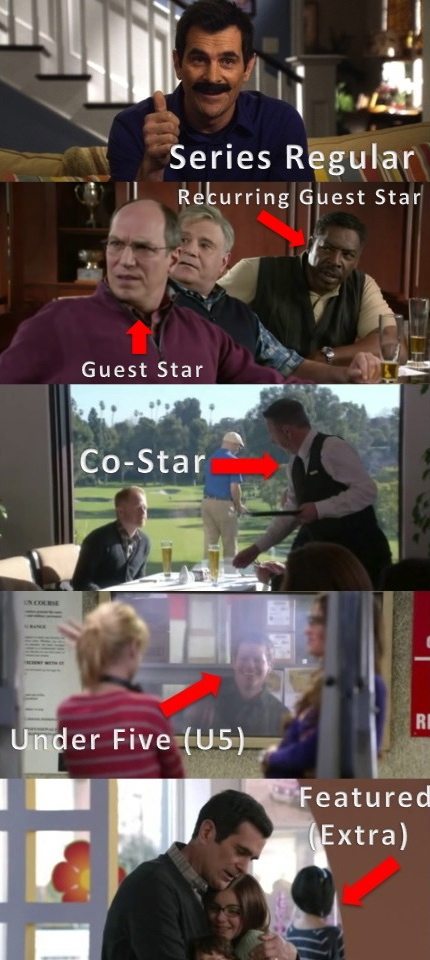
2.  Reoccurring, Guest Star, Co-Star…What’s the Difference?

Casting rank affects a number of factors, in particular pay grade and credit.  A lead actor will (usually) have a higher salary – and billing – than a supporting actor.  There are obviously exceptions to the rule (Marlon Brando in 1978’s Superman: The Movie), but the ranking system is fairly straightforward and formulaic. 
Marlon Brando in Superman: The Movie
(from www.capedwonder.com)

            Feature films have a very basic classification procedure, with there being three major categories—lead, supporting, and featured.  Each class is self-explanatory: the lead role is the star, the driving force of the film; the supporting role helps (or prevents) the lead from reaching and achieving his or her goals; a featured role can range from any sort of smaller role, from a bit part to a background extra (for more on that, please read this post).

            Television is a bit more complex; since it’s a serialized format, the supporting cast of characters is constantly changing.  Old faces are always returning to fight or support our lead series regulars.  The possible number of role classifications is far greater.  To help better understand all the technical jargon that’s often thrown around, please refer to this extremely useful diagram:

ABC's Modern Family
            The technicalities of being in the business of professional acting are not particularly complicated.  All it takes is perseverance, dedication, the absolute will to succeed and not ever, ever giving up.

Lights, camera, action.


 Got something to say about this?  Have any questions?  Comment below! 
Subscribe and follow us on Twitter for more!

By Alex Tafet