Pages

Across the Board (ATB) Talent, founded in 2008 by entertainment professional and entrepreneur Guy Kochlani, is a full-service licensed Talent Agency. ATB represents its talent "across the board:" theatrically, commercially, in print, hosting, voiceovers and dance. The limited client roster and staff of 10 enables ATB to remain committed to the goal of developing high quality talent while providing the personalized atmosphere of a management company.

Across the Board’s talent has been seen on numerous TV shows, films, commercials and theatre productions. Their models and photographers have been a part of major fashion campaigns and have been seen across the pages of domestic and international magazines.

ATB is honored to announce its move up into the big leagues. Using talent from across the board, ATB is currently packaging a major feature film as well as television series. As the client list becomes larger and more high-profile projects are being tackled, founder and CEO Guy Kochlani avows: “No matter how much we expand, our original business model will always remain on point. We provide one-on-one care and service to each client, no matter what.”

ATB represents talent and models in Los Angeles, Las Vegas and New York, with offices in Los Angeles and New York-Times Square. There are plans to open offices in London, Paris, and Tel Aviv.


For more info, check us out at WWW.ATBTALENT.COM

Monday, June 18, 2012

THE OTHER SIDE OF THE TABLE, Vol. I: So, You Have an Audition…


You did it.  You walked through that door into the waiting area, and the moment of truth is almost upon you.  Will the Casting Director like what he or she sees when you perform?  Is this it, THE opportunity, the one you’ve been waiting for all your life?  Is this the first step on the staircase to stardom, or will you receive a cordial smile, a pat on the back, and a “Good job, thanks?”


Handling auditions are often the toughest part of the job, and there’s real craft to nailing them.  It’s almost an art form, and it takes true skill and dedication. 

There’s a famous story about how David Carradine landed the lead role in the 1970s television series Kung Fu.  Carradine was reading for Kwai Chang Caine, a Shaolin monk on the run in the American Wild West.  On his way out of the audition, Carradine jumped up and kicked the wall, leaving a dark footprint by the doorpost.  After that point, it didn’t matter how many other actors came in—they found their guy, and that footprint on the wall was a constant reminder of that. 

Now let’s spice things up a bit!  Normally we give you Agency Tips (in multiple volumes!), but today’s different.  Please allow me to give the floor to a woman with experience from the other side of the desk, Arriane Alexander.

Arriane's journey to entertainment came from over a decade performing in the fashion world.  Her contagious star personality has led to consistently sold out performances of her show Big, Blonde & Beautiful at the legendary Cinegrill in the Hollywood Roosevelt Hotel, the M Bar in Hollywood, as well as shows at the prestigious Annenberg Theater in Palm Springs and the Colony Theater in Hollywood.  An incomparable presence, Arriane is sexy, powerful and 100% pure entertainment. 

So Arriane, what sort of notes would you give an auditioning actor?

“Be really clear about your type and what you are selling.  We hear lots about ‘type’ in the industry, and being in casting sessions makes it so clear how important it is for actors to understand who they are and what they are selling.  For instance, if you are a very quirky-looking, comedic type and you walk in wearing business attire, a serious headshot and a soliloquy from Hamlet prepared...well, that doesn't make sense to the Casting Director.  As an actor starting out, just present the easiest way for them to cast you.  If you are quirky, GO WITH IT!  Make everything you do quirky, and make that your brand.   Wait till you’re rich and famous to bring out the Shakespeare…unless of course you’re auditioning for Shakespeare.”

Identity is a big part about being an actor.  Know your strengths and weaknesses, your talents and faults.  Hollywood is filled with roles, and as an actor your task is to mold yourself to fit the one you’re reading for.  That’s what being a professional is all about.

“The epitome of professionalism is an actor who comes into the room completely confident, looks the part and is prepared.  Everybody in the room relaxes because you know what to do.   When an actor comes in like that, it is very exciting.  Despite everything, at the end of the day the Casting Director wants you to nail it.  They’re always looking for the next big discovery.  Being prepared sounds so easy, but it is not...so many actors don't have all the moving parts put together in a whole package.”

Thank you, Arriane!  There you have it, guys and dolls, an inside look at how to prepare physically, emotionally and mentally for an audition!

So, you have an audition…what’re you going to do about it?

Lights, camera, action.


Arriane Alexander is proud to debut her new class “How to Present Yourself Like a Pro” at The Actor’s Key on July 11th!  A FREE preview class will be held on June 28th at 8:00PM.  Visit www.actorskey.com for more details.

For more on Arriane Alexander, visit her website: http://www.arrianealexander.com/


Got something to say about this?  Have any questions?  Comment below! 
Subscribe and follow us on Twitter for more!

By Alex Tafet

Tuesday, May 1, 2012

$200 Million Update: THE AVENGERS vs. THE DARK KNIGHT RISES: It's Not a Battle, It's a Team-Up

$200.7 MILLION UPDATE: It's official: Marvel's The Avengers smashed all sorts of opening weekend box office records, taking in $200.7 million domestically and bringing the worldwide total to an unprecedented $654.8 million.  I'll give you a moment to let that sink in.  This movie grossed over half a billion dollars worldwide in two weeks.  Take note, Hollywood: this is what happens when you give your comic book properties to genuinely talented filmmakers who love and understand the characters and world.

            This summer is dominated by two behemoth films: Marvel's The Avengers (May 4th) and The Dark Knight Rises (July 20th).  Both are part of the comicbook genre, both have massive established fan bases, and both will makes tons and tons of money.  Basically, it's a good time to be a fan.

But why does there seem to be this online rivalry between the two?  Shouldn't we, the fans, be embracing the fact that we live in a time where The Avengers and Batman are actually in movies that people love?  Last night the new trailer for The Dark Knight Rises was released, and the Internet is ablaze with debates and arguments about which will be the "better" film.  Why can't both be great?

Now look, I'm a huge geek.  I live for these sort of movies, and when I see people fighting over them it just breaks my heart.  I had two different, yet totally visceral in their own way, reactions to the new Batman trailer and The Avengers one.  With The Avengers, I choked up.  Honestly, when we see that shot of Hulk catching Iron Man, tears swelled.  These are images I'd waited my entire life to see, and to watch it all come together was a perfect experience.  With The Dark Knight Rises I really feel it in my gut.  This trailer hits my hard emotions—fear, sadness, finality, and I think that's the point.  This is a beloved saga coming to a definitive conclusion.  In an odd sort of way it feels like losing a loved one.

These two films are wholly unique from one another.  They both represent conclusions: The Avengers is a 5-year saga coming together, and The Dark Knight Rises is the Nolan-Batman trilogy reaching its end.  The Avengers opens new doors, The Dark Knight Rises closes them.  They are two very different movies, occupying two very different universes.  They are incomparable.  I don't expect to feel the same when watching both, and that's absolutely okay.  I love films because they are dreams come to life...and dreams are never the same.


UPDATE 2: Oh, and there’s also a new Spider-Man movie coming out.  Check out the new trailer.


Lights, camera, action.

Got something to say about this?  Have any questions?  Comment below! 
Subscribe and follow us on Twitter for more!

By Alex Tafet

Wednesday, April 25, 2012

AGENCY TIPS, VOL. III: Acting on Acting


There is one immortal, self-reflective question that we all constantly ask ourselves: how can I make myself better?  The answer is rarely a simple one, let alone evident—but it’s there.

Acting is no different.  One can always be better; that door never closes.  Acting is, at its core, an art form, with the objective being to personify emotionality into something tangible.  It’s about taking that “…” and creating drama.  And in order to do that you need to get out there and freaking act

So how do you do it?  Which is the best road to success?  Well that’s the million-dollar question, ain’t it?  Luckily, your friendly neighborhood Across the Board Talent writer has assembled a few pointers that will help you on your way!

1.    Acting Classes

Acting is a like a muscle: if you don’t work it out, it’ll melt into gross slop.  As an actor, you need to exercise and train, and that doesn’t mean sitting on the couch sipping gin & tonics while reading Harold Pinter plays.  Go out into the world and really interact with people.  Get to know human functions on an intuitive level.  One way to do that is by participating in acting classes.

Acting class is the same as trade school in that one goes there to learn and become better at a craft.  Classes force actors to interpret texts and stretch their emotive range, bouncing their material off the other classmates.  Monologues are great, but compelling dialogues?  That’s why movies are made.

Let’s take a step back and be honest with each other for a second, okay?  Some actors have a bit of a, for lack of a better word, ego.  “Acting classes?  Pft, I’ve had all the training I need.  What more do I have to learn?”  There is no such thing as too much training.  Buddy, even Brad Pitt takes lessons.  Granted he has a private acting instructor, but still…he receives coaching. You always need to flex those muscles.

Remember folks: leave that ego at the door.  In the immortal words of Katherine Hepburn, “Acting is the most minor of gifts, and not a very high-class way to earn a living.  After all, Shirley Temple could do it at the age of four.”

2.  Casting Director Workshops

Casting Director workshops are often great ways to meet – and subsequently show off to – Casting Directors.  These are the people in the business who get you past the door and onto the stage, and being on their good side is a coveted position.

            These CD workshops can be very delicate environments and, like everything else, there is a right and wrong way to approach them.

The Webseries Good Job, Thanks!
            WRONG: Enroll in every CD workshop under the sun.  The “if they’re selling, I’m buying” mentality is exactly what not to do.  If you’re taking five different workshops, you won’t be able to really concentrate and develop a proper relationship with the CD in charge.  Make your class choices more focused and determined.  To just sign up for everything is a waste of time and money, and it reeks of desperation.

            RIGHT: Do your research and be selective.  Don’t stretch yourself too thin with these classes, and really take the time to acquire a legitimate rapport with a Casting Director.  Create a list of projects (film and television) that you love and want to be part of, and then find that Casting Director.  If he or she is holding a workshop, congratulations!  You just found your calling.

            Most importantly, always follow up your workshop with a lovely “Thank You” note to the Casting Director, especially if your performance received rave reviews.  Create that connection with your acting, and do whatever it takes to keep it alive.

            (NOTE: Looking for workshops near you?  Your best friend Google has all the answers!)

3.  Try the Theater

Fact: Moms love Clooney.
            If being a successful actor in the entertainment industry were easy, more people would be doing it.  My mother would be able to rattle off twenty, thirty names instead of the usual two (“George Clooney and George Clooney’s hair”).  This business is tough.  Actors need to explore every outlet to work and be noticed…and that’s where the theater comes into play.

NEW YORK ACTORS: The Los Angeles theater circuit does not have the same level of panache as it does in New York.  Feel free to skip the following paragraph.

            Theater acting is an excellent way to hone your skills as an actor.  There are no cameras, no multiple takes…just you and the audience.  On stage an actor builds confidence and style, because there is no editor in a dark room somewhere cutting your performance together into something “film ready.”  Your fate lies in the hands of one person: you.

            Acting on stage also provides actors with more direct opportunities to give back to the community.  Whether performing for children, the elderly, or at the Geffen Playhouse, theater acting is a far more intimate experience than being projected onto a screen.  You as an actor have the ability to truly connect with the audience.  Your performance has the potential to affect someone out there in the dark, cool theater in a positive, visceral way.  There is a very personal, private connection made between the actor on stage and the audience in the theater that is often absent from the cinema.


            Every time an actor acts before an audience, whether live or on screen, he or she creates the potential for progression.  There is always a young boy or girl out there in the black theater, watching intently, analyzing and absorbing every one of your moves.  How will you affect this person?  Will you create a fallacy, some sort of façade that hides your true self?  Or will you be sincere and pure, portraying something emotionally honest that captivates the audience?

            As an actor you have the power to affect those around you.  You are an influence, an inspiration.  The question remains: what will you do with that power?

Light, camera, action.


Got something to say about this?  Have any questions?  Comment below! 
Subscribe and follow us on Twitter for more!

By Alex Tafet

Monday, April 2, 2012

SAG-AFTRA: Everything You Need to Know

Well, it’s official.  The Screen Actors Guild (SAG) and the American Federation of Television and Radio Arts (AFTRA) have merged, and Michael J. Fox couldn’t be more excited. 

But what does that mean for you, the actor?  How is your contract affected?  If you belong to either union (or both), do you now have to pay a new initiation fee?  Have the application rules changed?  The answers to these questions and much more can be found below in the official SAG-AFTRA FAQ, taken straight from www.sagaftra.org!

REMEMBER: If you are currently a member of SAG-AFTRA, update your actor’s profile (Actor’s Access, Casting Networks, etc.).  This is a vital step toward the next stage of your career!


Click to enlarge.   http://www.sagaftra.org


Tuesday, March 6, 2012

AGENCY TIPS, VOLUME II: Understanding Unions & Casting

Hollywood is a funky sort of place built on tradition and intricacies.  Everything works in a very particular way, and to break the trend is to be ostracized.  Falling in line and following the established rituals is practically as important as the acting itself.

Newcomers tend to become very confused by all the different facets of the industry.  “What’re the guilds?”  “How much do I get paid?”  “People will take me seriously if I say I was a featured extra, right?  I mean…I was featured!”  These are common inquiries, and lucky for you we at Across the Board Talent have all the answers you’ll ever need!

1.  Should I Join a Union?  SAG, AFTRA…or Both?

These questions top every agency’s Frequently Asked Questions list, and the answer remains consistently the same: maybe, it depends.  The business of acting is interesting and unique in that is made up of both variables and absolutes, with the two never mixing.  Ask five people and you’ll get seven different answers.  You need to analyze your career, where you are and where you’re headed, and decide with your representation what works best for you.

But before we get into that, let’s take a look at what exactly it means to be part of an actor’s union, particularly the Screen Actors Guild.  Their mission statement (according to the SAG website) is “to enhance actors’ working conditions, compensation and benefits and to be a powerful, unified voice on behalf of artists’ rights.”  SAG represents “over 125,000 actors who work in film and digital motion pictures and television programs, commercials, video games, corporate/educational, Internet and all new media formats.”  Basically, they have their hand in every facet of the entertainment industry that requires legitimacy.

“But Alex, how do I get into SAG?  I heard something about being Harley Davidsoned in?”  There are actually two ways to become what is known as “SAG Eligible.”  The first way is to book a principle role in a SAG project (feature film, television series, etc.), in which case you automatically become eligible due to the Taft-Hartley Act of 1947 (also known as the Labor-Management Relations Act).  The purpose of the Taft-Hartley Act is to monitor the activities of labor unions, as well as to “promote the full flow of commerce, to prescribe the legitimate rights of both employees and employers in their relations affecting commerce, to provide orderly and peaceful procedures for preventing the interference by either with the legitimate rights of the other, to protect the rights of individual employees in their relations with labor organizations whose activities affect commerce, to define and proscribe practices on the part of labor and management which affect commerce and are inimical to the general welfare, and to protect the rights of the public in connection with labor disputes affecting commerce.”  Union leaders original called the Taft-Hartley Act a “slave-labor bill,” and President Harry Truman vetoed the Act, calling it a “dangerous intrusion on free speech,” but Congress overturned his opposition.  I bet you’re starting to wish you had paid attention in that Political Science class during Sophomore year, huh?  


The second way to become SAG Eligible is to book three separate background jobs (i.e., featured extra) on three SAG projects.  With each job you may be given a SAG voucher (if you're lucky, as there is a limited amount), moving you one step closer to becoming a fully-fledged member of SAG.  Then double-check your eligibility on the SAG website, pay the necessary $2,500, and enjoy!

SAG Voucher from www.smartactors.com.
If you’re new to acting, however, SAG status can actually be detrimental to your career.  SAG Eligibility gives you a choice: to join or not to join.  This is the best place to be for a newcomer, as you can still participate in those non-union projects while simultaneously going out for the bigger union gigs.  Though SAG offers a wide array of attractive union benefits and compensations, it is sometimes best to hold-off on that till you become a more reputable performer.  If 80% of the auditions and bookings you’re getting are non-union projects, it may be worth holding off on joining SAG.  Once a SAG member, you are forbidden from working on any non-union projects. 

(The only exception to this would be to declare SAG Financial Core, which means that you become a “fee paying non-member,” forfeit your membership and are viewed as anti-union by all Guild members.  This is only for last resort, “I can’t pay my rent” type of scenarios.)

Joining the American Federation of Television and Radio Artists (AFTRA) is another story.  AFTRA is “is a national labor union representing over 70,000 performers, journalists and other artists working in the entertainment and news media,” and its application process is far simpler than SAG’s.  All that is required is payment of the $1,600 initiation fee, and BAM!  You’re in.

The big news lately has been about the reported unification of SAG and AFTRA.  If you’re an AFTRA member and SAG Eligible, should you join SAG now or wait till after the two unions merge?  The [rumored] application fee will be $3,000, so if you see SAG in your future, send in your down payment now.

At the end of the day the decision of whether or not to become a union member rests on the current status of your career.  Certain projects – particularly the high-profile ones – require membership to at least one major union.  This is a big, important choice, and one that needs to be properly evaluated with your representation.

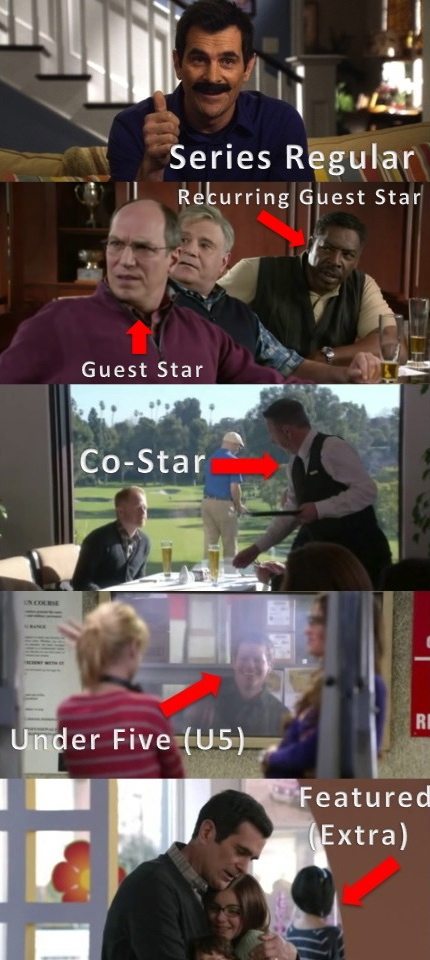
2.  Reoccurring, Guest Star, Co-Star…What’s the Difference?

Casting rank affects a number of factors, in particular pay grade and credit.  A lead actor will (usually) have a higher salary – and billing – than a supporting actor.  There are obviously exceptions to the rule (Marlon Brando in 1978’s Superman: The Movie), but the ranking system is fairly straightforward and formulaic. 
Marlon Brando in Superman: The Movie
(from www.capedwonder.com)

            Feature films have a very basic classification procedure, with there being three major categories—lead, supporting, and featured.  Each class is self-explanatory: the lead role is the star, the driving force of the film; the supporting role helps (or prevents) the lead from reaching and achieving his or her goals; a featured role can range from any sort of smaller role, from a bit part to a background extra (for more on that, please read this post).

            Television is a bit more complex; since it’s a serialized format, the supporting cast of characters is constantly changing.  Old faces are always returning to fight or support our lead series regulars.  The possible number of role classifications is far greater.  To help better understand all the technical jargon that’s often thrown around, please refer to this extremely useful diagram:

ABC's Modern Family
            The technicalities of being in the business of professional acting are not particularly complicated.  All it takes is perseverance, dedication, the absolute will to succeed and not ever, ever giving up.

Lights, camera, action.


 Got something to say about this?  Have any questions?  Comment below! 
Subscribe and follow us on Twitter for more!

By Alex Tafet

Tuesday, February 28, 2012

OSCAR ROUNDTABLE: A Critical Analysis of the 84th Annual Academy Awards


The Academy Awards are the crown jewel of Hollywood.  If a film is released and it’s excellent, the first critical response is, “[blank] is the first Oscar-worthy movie this year!”  The Awards are the golden ticket that everybody wants to win.  Now, the question of what is truly the “best” film of the year is debatable (the Oscars more often than not tend to do a pretty decent job of picking nominees that are at least serviceable), but every year the Academy is consistent in one thing: disappointment.  How many times have you exclaimed “That won?!” or “I’ve never even heard of that movie!” while watching the three-and-a-half hour telecast?  I still haven’t fully recovered from the 2009 snub of The Dark Knight.

Despite all that, the great thing about the Oscars, and their nominations, is that they promote healthy debate and discussion.  It’s only when you’re forced to deliberate the merits of your favorite film that you start to look deeper into it, analyzing the film in all its multi-layered facets.  Films become texts, not just entertainment…and that’s when the real fun starts.

My friends Saryah, Jared, and I, film lovers all, are a very vocal, opinionated group of guys.  I’m talking the New York-style loud and obnoxious; nothing is ever good enough.  Criticizing the Oscars is practically our hobby, and when the show was in full swing and Hugo beat Rise of the Planet of the Apes in the Visual Effects category, well…it took every ounce of strength I had not to throw a butcher knife through my television. 

For your reading pleasure we have a conducted a roundtable review and analysis of the 84th Annual Academy Awards, detailing everything from the presentation to the award winners.  This time, it’s personal.

Alex: So guys…the Academy Awards.  The Oscars.  The naked-guy-with-a-sword statue awards.
Jared: The 84th Annual naked-guy-with-a-sword statue awards.
Alex: I stand corrected. 
Saryah: Can we just call it the “What the Hell is That Doing There, it Sucked” awards? 
Alex: Did you know that, and someone might need to double-check this, Extremely Loud & Incredibly Close is the poorest reviewed movie to ever be nominated for Best Picture?
Jared: It has a 47% rating on RottenTomatoes.com.
Saryah: That’s rotten.  But it has Tom Hanks, so…
Jared: They must have really pimped those “For Your Consideration” ads.
Alex: They probably pimped a lot more than that.  But let’s talk about the show.  First, Billy Crystal.  What’d you think: bold and risky, or predictably comfortable?
Saryah: Meh.
Jared: I thought he—
Saryah: I said meh.  He was okay.  Nothing special.  Other than calling Nick Nolte out on sounding exactly like a motorcycle engine, there was really nothing new here.
Jared: Crystal was clearly hosting above the belt, something that may have been different had Eddie Murphy been given the go ahead before Brett Ratner's gay comments. Sure it was entertaining, as it is typically is every year, but there were no real wow moments.

Bret McKenzie & Kermit the Frog
Alex: I miss Hugh Jackman.  That was an increasingly fun performance.  There are very few actors in Hollywood who have the level of showman presence – or talent – as Jackman.  And was anybody else a little upset that Bret McKenzie’s song “Man or Muppet” wasn’t performed? 
Jared: It would have been cool to see Jason Segel perform it, especially after it won for Best Song. Even though the lack of a musical performance was generally favored this year, a rendition of that song would have been entertaining.
Saryah: Eh, who cares?  I was just happy the telecast was shorter than usual.
Jared: Well, this year, more than any in recent memory, played very much like a script.  Counting last night, Crystal has now hosted 9 times. It's time to throw out the safe card, which was very much the theme of the night, and find a performer who will be scandalous and racy. 

Billy Chrystal hosting again...what are your thoughts?
Alex: I’m glad you brought that up.  One of the themes of the Awards was “being safe.”  Everything, from the nominees to the décor of the theater, was just one big throwback to the cinema of yesteryear.  The focus of the night was channeling what once was, rather than appreciating what we have now.  Hell, the Best Picture winner practically exists on the idea of nostalgia.
Saryah: Anybody with an Internet connection knew that The Artist was winning Best Picture.  Maybe that’s why they tried to make the whole award show feel as “olde time” as possible.  Someone should have told Billy Crystal they were making it old fashioned so he didn’t have to try and shave 367 years off his life. He's been hosting the Oscars since the last time a silent film won.  What’s wrong with looking your age?
Alex: Again, nostalgia. 
Saryah: They even had theater attendants handing out popcorn!
Alex: And probably cigarettes.
Saryah: I was surprised, they didn’t hand anything to Angelina Jolie.  Get that girl a sandwich.
Jared: If Angeline Jolie does not gain weight within the next 48 hours, she might start slipping through cracks.
Alex: That was a nice leg, though.  But anyway, right from the get-go things started off at a slow pace, and everything seemed like it was going to be smooth sailing.  Predictably, Harry Potter and the Deathly Hallows Part II was going to nab the Best Makeup award, right?

Nick Dudman creating a goblin.
Saryah: Guess which movie’s makeup team turned an American actress into a weird, mannish Brit?  If you answered either Albert Nobbs or The Iron Lady, congratulations!  You’re correct.  For those at home who don’t get the joke, let me clarify: THERE WAS NO DIFFERENCE BETWEEN THE TWO.  How about Harry Potter, the one other nominee?  Oh, all they did was make a dwarf look like a goblin and gave some guy a snake’s nose.  Pretty bland stuff.
Alex: You’re starting to touch on what is by far my biggest peeve with the Academy.  Time and again I find that the films that are genuinely deserving of honor are overlooked.
Saryah: *cough* The Dark Knight *cough*
Alex: …Exactly.  Take Best Makeup, like Saryah said.  Yes, both Albert Nobbs and The Iron Lady offer extraordinary achievements in the field, but Harry Potter created other worlds.  New species came to life!  It’s like Star Wars set on Earth, and something of that nature deserves to be rewarded.  Making people look older, or fatter, or just weird is nothing new.  It’s, like Jared said in regards to the theme of this year’s Oscars, safe.  And that brings me to the Visual Effects category.
Jared: Oh no.  Here we go.
Alex: Look, you guys know what a massive proponent I’ve been for Rise of the Planet of the Apes in every possible outlet.  Andy Serkis should have been at least nominated for Best Supporting Actor, but whatever.  I get it.  What he did was new, the Academy is old, and that’s that.  I only assumed that Apes had the Visual Effects Oscar in the bag.  I mean, they took the motion-capture technology revolutionized by Avatar and said, “Hmm, how can we make this better?”  And then they freaking did that.
Jared: They revolutionized what was revolutionized.
Alex: The team behind Apes created a character that was so unbelievably lifelike and seamless that my dad kept asking me if it was a real ape.  For them to lose the category is not only preposterous, proving that the voters don’t understand the category…it’s also insulting.  I’ll say it here: Hugo does not deserve that award, and I hope its team of artists understands that.

How did this not win the Visual Effects award?
Jared: Hugo was a stunningly beautiful film, but you never really got the sense of visual effects playing a substantial role. On the other hand, both Transformers: Dark of the Moon and Apes exist on the quality and believability of their visual effects. I guess blowing up Chicago and creating an ape from a live actor’s performance was less impressive to the Academy than a reconstructed image of Paris.
Alex: And you know what?  The CGI in Hugo wasn’t even that great!  That one scene they kept showing during the ceremony, of the gears moving around as the boy turned into the robot, has CGI that is painfully obvious!  Isn’t the point of good visual effects to create a totally immersive experience?  The viewer should be unaware than effect is even taking place on screen.

This is not CGI.
Saryah: Rate in order of which is the odd man out: making dragons and having people fly around on broomsticks, massive robots fighting each other for 2-hours, slightly smaller robots fighting each other for 2-hours again but in boxing rings this time, monkeys so life-like that PETA doesn't know what to do, or a train driving through a wall and a little boy dreaming he was a robot who doesn’t even fight any other robots?
Jared: I hate your mind-games.
Saryah: If you’re a 70-year-old white man, the answer is obviously the train going through a wall with the little boy/robot-thing.  Thanks Academy for letting these talented men and women know that just because the demographic their films targeted was the general movie going public, their work is essentially worthless.
Alex: You know, there’s something about Hugo that’s been bugging me for a long while.  For the record, I really enjoyed the movie.  It was a gorgeous, nice film, and the use of 3-D was great.  But at the same time it, and let me know if you guys sort of feel the same way, didn’t feel like a Scorsese.  A number of critics have been pointing this out, and Crystal even poked fun at it, but I think it comes down to this: Hugo is a Steven Spielberg movie, not a Martin Scorsese movie.
Saryah: That literally makes no sense.

Steven Spielberg directing Henry Thomas on the set of E.T.
Alex: Bear with me.  Scorsese’s films have the common theme of corruption and violence.  The settings and players change, but the meat of the texts always remain the same.  Spielberg, on the other hand, deals with wonder and child empowerment, as seen in E.T., Close Encounters of the Third Kind, Jurassic Park, and both War Horse and Tintin.  His entire mission is to instill a sense of awe in his characters, and through them the audience.  That was Hugo.  The film’s appreciation for old cinema, and the excitement of rediscovering it, was executed in playbook Spielberg fashion.  Now, would the film have garnered as much award attention if Mr. Spielberg directed it?  Historically speaking, no, as the Academy has a tendency to shut Big Steve out.  Even so, it makes me wonder what a live-action, 3-D, Steven Spielberg-directed Hugo would have been like. 
Jared: I kind of agree.  In all honesty, it did seem like something that Spielberg would have done. We have come to identify Scorsese with “racier” flicks like Goodfellas and The Departed. Though Hugo was intended for children, it definitely contained elements that would likely go beyond the cognitive beyonds of 6-12 year-olds.  It was completely out of his element, but I'm sure he's not complaining about the results.
Alex: Saryah?
Saryah: I’ll let you know when I see it.
Alex: Okay then.  Moving on.  The acting categories. 
George Clooney hiding.
Jared: George Clooney definitely cried and ran out of the theater after losing out the Best Actor award to Jean Dejuardin.
Saryah: Jean absolutely deserved that award, not even a question.
Alex: The acting awards this year were fairly predictable.  I don’t know anybody who didn’t have Dejuardin, Christopher Plummer, and Octavia Spencer on their ballots.
Jared: Ahem…
Alex: Oh right!  Saryah picked Clooney!  How’s that working out for you?
Saryah: I was betting on the dark horse.  Look, if I was Mr. Plummer I would have started practicing my Oscars acceptance speech right after they announced the nominations.

Meryl Streep wins her first Oscar since 1982.
Alex: Yeah, that was a cakewalk.  I think we all got Best Actress wrong on our ballots, right? 
Jared: It seemed like a damn sure bet that Viola Davis was going to take the crown for her role in The Help. Given the subject manner of the movie, it seemed that Meryl Streep was a lock for the role of runner-up, especially since her last best actress win was for Sophie's Choice in 1982. I'm not going to say that she wasn't worthy of the Oscar but when you're nominated 17 times over a span of 4 decades, isn't that enough?
Saryah: I'm so sick of this woman.  We get it.  You've been nominated a lot.  That's no excuse to indignantly say that you'll “never be up here again.”  No, you probably will be up there next year because all you do is try to get up there. Is she a phenomenal actress?  Undeniably.  But think about this: in all of her movies do you even NOT think your watching Meryl Streep?  Was she Julia Childs?  No, she was Meryl AS Julia.  Was she Margret Thatcher?  No, she was Meryl AS Margret.  While everything about her performances is truly great, she never lets the audience forget who they’re really there to see.
Alex: Wow, I could not possibly disagree more.  Ms. Streep is one of, if not the, greatest working actresses.  She’s a chameleon, and is unique in her ability to portray any sort of role at any time.  It was a tough call between her and Viola Davis, especially considering the fact that Ms. Davis rocked every single Guild award.
Jared: Meryl was clearly not supposed to be the winner for Best Actress this year. She knew it and Viola Davis knew it.  There seems to be a trend now towards giving the supporting actress to an African American and then snubbing them for best actress, like with Precious.
Alex: That had nothing to do with race.  The lead actress in Precious was not deserving of a Best Actress win. 
Saryah: Exactly.  Acting is acting.  And the best acting of any of the Best Picture nominees was in The Artist. 
Alex: So you’re okay with The Artist taking home the big one?

They're waiting to be handed the Oscar.
Saryah: Completely agree with that one. Even if this was a good selection year I think The Artist would give any film a run for its money. But like we’ve been saying, how about giving us some suspense?  They should have announced this one right away just to get the show over with.  Let the people watching in New York get to bed early.         
Alex: None of my favorite films of the year were even nominated.  Most of them don’t tend to fit into the “Academy mold,” I grant you, but even so.  I think the fact that Harry Potter and the Deathly Hallows Part II made more money at the box office than the nine Best Picture nominees combined says something about the current state of the Academy.  People just don’t care that much anymore about the awards when the movies they love don’t make it into the bracket, and that makes the show boring.  Last year we had Toy Story 3 and The Social Network, and the year before that we had Avatar and District 9.  What do we have now?
Jared: The beauty of the Oscars bracket is not knowing who’s going to win. That's what makes it so exciting, like the NCAA college basketball pool. There's always a Cinderella story somewhere, and someone always finds it. This year though, such a nominee was notoriously absent and the Oscars suffered greatly because of it. 

Alex: The picks this year were uninspired, and the show was neither exciting nor creative.
Saryah: The Oscars were boring and predictable, but with enough nostalgia to make it bearable.  The choices showed no imagination, and the whole night reeked of pandering to established stars.
Alex: Again Saryah, you’ve touched on the key word of the day, which is “nostalgia.”
Saryah: Thanks Alex, I try.
Alex: I ask my classic question: if we are so focused on celebrating the past, how are we supposed to move forward?  Art must evolve, and for that to happen we need to analyze and appreciate what once was whilst at the same time taking the necessary risks to break new ground.  Film as an art form needs to constantly move forward, improving on itself.  Otherwise we’re just treading water.
Jared: Exactly. 
Saryah: True…but The Artist was still great.
Alex: Fine.  I’ll give you that.  So I guess it’s up to us to take those first couple of steps to the future.
Saryah: Your mission, should you choose to accept it…
Jared: I have no problem with that.
Alex: Okay.  Mission: accepted.

Film, like any art form, must be in a continuous state of flux.  It must be able to stylistically propel itself forward while simultaneously taking the time to look back.  It’s a symbiotic relationship—we learn from the successes and failures of the past and spark our creativity with dreams of the future.  As Ben Kingsley’s Georges Méliès says in Hugo, “If you've ever wondered where your dreams come from, you look around... this is where they're made.”

Lights, camera, action.


 Got something to say about this?  Have any questions?  Comment below! 
Subscribe and follow us on Twitter for more!


By Alex Tafet